
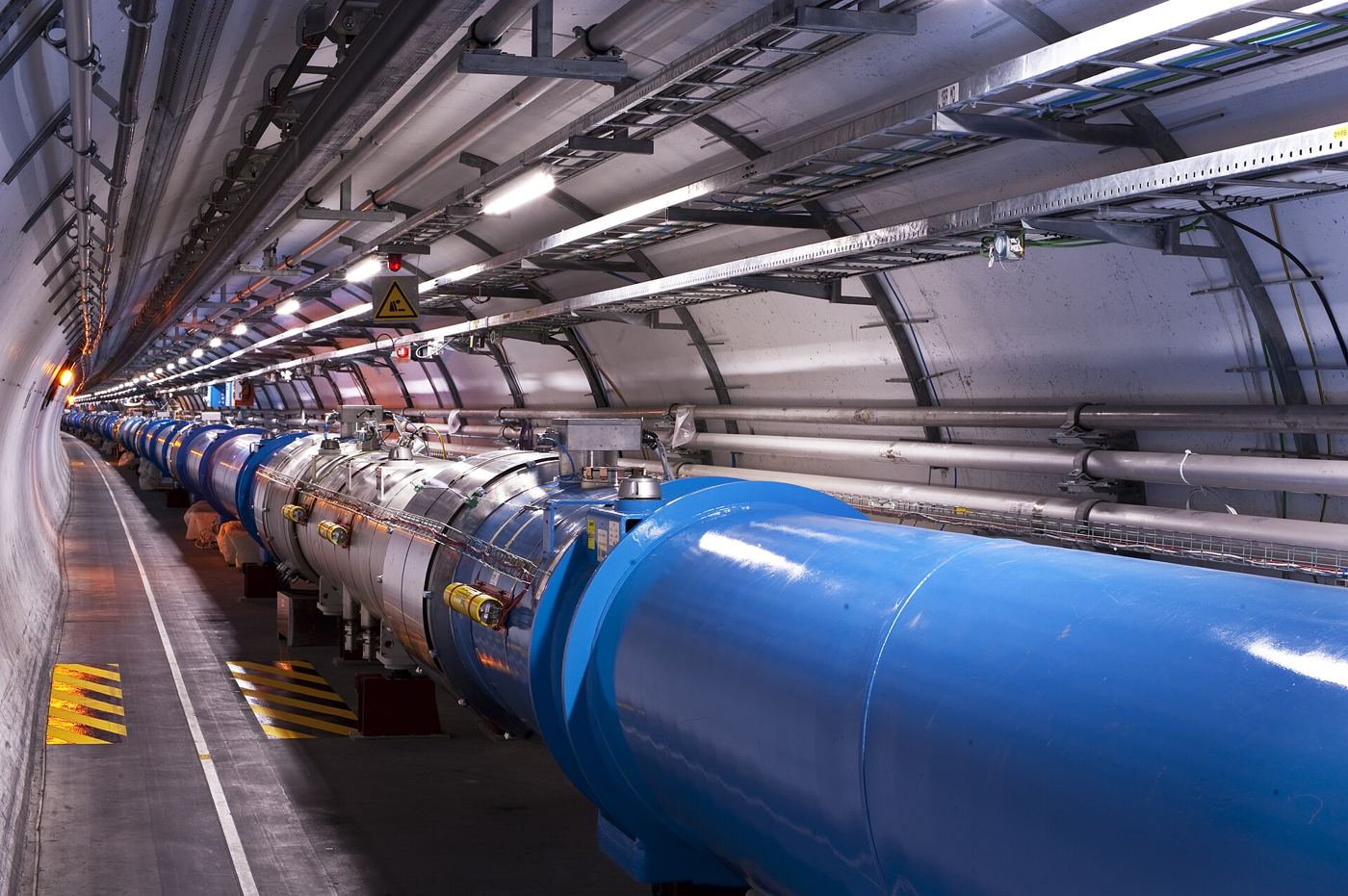
Physicists at CERN’s Large Hadron Collider have found the first evidence of the rarest decay of a beauty particle ever seen, ending a search that began 42 years ago. The result, announced by the international LHCb collaboration on 3 November 2026, concerns a decay known as Bd to mu mu, in which a particle containing a beauty quark decays into two muons, heavier relatives of the electron. The process is predicted to occur only about once in every ten billion beauty particles. The result has a statistical significance of 3.2 sigma, enough to count as the first evidence of the decay, although below the five-sigma threshold physicists require to claim a discovery. A key role was played by the upgraded LHCb detector’s Vertex Locator, a silicon pixel detector assembled by researchers at the University of Liverpool, which sits just five millimetres from the LHC beams.
What the Evidence Shows
The measurement is a test of the Standard Model, the theory that describes fundamental particles and their interactions. So far the new results agree with the theory’s predictions, but studying such extraordinarily rare processes with increasing precision could reveal signs of previously unknown particles or forces. The analysis also produced the most precise measurements yet of a related decay, Bs to mu mu, first observed by LHCb in 2015. The researchers describe the work as a step toward exploring the Zeptoverse, the world of distances around a billionth of a trillionth of a metre, where new particles and forces may be hiding. Professor Tara Shears of the University of Liverpool, the LHCb-UK spokesperson, said the result opens up new opportunities to explore some of the most fundamental mysteries of the Universe. Reporting and analysis from sources such as Nature track the same developments, and specialists following the rare Bd to mu mu decay say the direction is now consistent across independent lines of evidence.
The Wider Context
The wider context is a research landscape in which replication and open data now decide reputations. Findings connected to the rare Bd to mu mu decay are being checked by independent groups with shared datasets, and the teams involved publish their methods in full so rivals can test every step. That discipline is slower than a headline cycle, but it is why results in this area increasingly survive first contact with scrutiny.
What Happens Next
What happens next in the story of the rare Bd to mu mu decay will be decided by follow-up work already under way: larger samples, longer observation and instruments that have not yet come online. The researchers involved are unusually united on one point, that the current results justify the next investment of time and money. Readers will not have to wait long for the first tests of that claim. You can follow related developments in our coverage of science.
None of this will be settled by a single announcement, study or product launch. The pattern to watch is accumulation: independent confirmations, honest reporting of failures and steady improvement in the underlying numbers. Readers who follow those signals, rather than the loudest claim of the week, will understand this subject better than most of the commentary surrounding it suggests is possible.
