
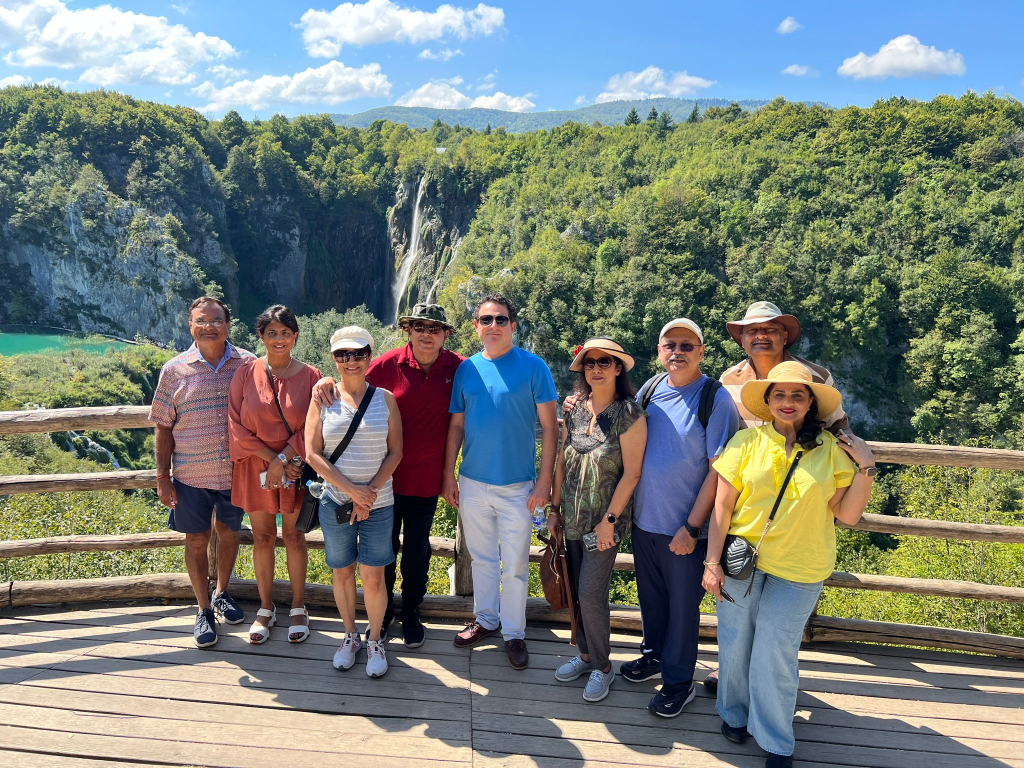
Most travelers who plan Croatia on their own come home wishing they had done it differently. They spend half their days stuck in ferry queues, eat at restaurants built for cruise crowds, and miss the quiet courtyards where the country actually breathes. A private tour Croatia fixes that problem before it starts. It also gives you something rarer: time to sit with what you see.
Split and the Palace That Became a City
Split looks like an ordinary Croatian port until you walk through one of its old gates. Then the city changes. You are standing inside a Roman palace that Emperor Diocletian built between 295 and 305 AD as his retirement residence. A private tour in Croatia often starts right here. It remains the largest and best-preserved example of Roman palatial architecture, representing a transitional style half Greek and half Byzantine.
After Rome collapsed, refugees from nearby Salona fled inside the abandoned walls. They built homes against Diocletian’s columns. Their descendants still live there. Today, the palace forms about half of the old town of Split, with 3,000 inhabitants and numerous shops, boutiques, cafes, and bars. The cathedral at the center was once the emperor’s tomb.
A private guide walks you past cellar halls that most tourists rush through. You hear about the persecution of early Christians by the same emperor whose mausoleum later became their church. Some of those stories are odd, perhaps a little uncomfortable, but they are part of why Split feels different from any other Mediterranean city. The cellars themselves stayed sealed under garbage for centuries.
Dubrovnik and the Walls of an Old Republic
Dubrovnik began as Ragusa, a small city-state that survived for nearly five centuries by playing east against west. The walls grew slowly between the 13th and 17th centuries. At times, the walls are as thick as 6 meters (20 ft) and, in certain sections, reach heights of up to 25 meters (80 ft). They run almost two kilometers around the old town.
The Venetians wanted the city. So did the Ottomans after they took Constantinople in 1453. Ragusa held on through diplomacy and stone. After Bosnia fell in 1463, the locals invited the famous architect Michelozzo di Bartolomeo of Florence to come and direct the fortification of their walls. Fort Bokar and the Minčeta Tower went up in the same decade.
Walk the ramparts with someone who knows the dates and the deals. Jewish gravestones are integrated into the walls themselves, near the old Jewish quarter. You also learn why Lovrijenac Fortress was built in three months. The Ragusans were racing Venetian ships carrying materials for a rival fort across the harbor. When the ships arrived, the locals told them to turn around and go home.
Adriatic Villages Few First-Time Visitors Find
Past Split and Dubrovnik, Croatia opens into islands and small harbor towns. Hvar Town sits inside 13th-century walls, with Gothic palaces and marble streets polished by centuries of foot traffic. The Venetians originally built the fortress above the town in the 12th century, and the upper levels were rebuilt after a 16th-century gunpowder explosion.
Korčula is quieter than Hvar. The old town follows a fishbone pattern, so the wind cools the streets in summer, and the walls block it in winter. Locals will tell you Marco Polo was born there. Some historians push back on that claim, though the house people visit still stands and the story is fun to hear in person.
Off Korčula, divers found a submerged stone road in 2023 connecting a sunken prehistoric settlement to the coast, radiocarbon-dated to around 4,900 BC, almost 7,000 years old. The road belongs to the Hvar culture, a Stone Age people who made pottery along this coast while most of Europe was still hunting and moving across the land.
Why Private Beats the Alternative
Group tours work for travelers who do not mind crowds, fixed schedules, and surface-level history. A private driver-guide moves at your pace. You choose the village. You choose the lunch stop. You ask the guide to slow down at the mosaic floor in Diocletian’s basement, or skip it entirely.
You also avoid the small disasters that wreck self-planned trips. Missed ferries. Closed roads on Pelješac during wine season. A restaurant with an English menu serving Russian crab sticks instead of fresh Adriatic fish. These are the things that turn a Croatia trip into a story your friends quietly avoid asking about later.
Jordan and the team at All Private Tours plan every stop around your interests. Hand-picked guides, late-model vehicles, hotels chosen for the right view rather than the highest commission, and a phone number that picks up in seconds. You are never figuring it out alone.
Ready to see Croatia the way it should be seen? Tell us your travel ideas and we will design a private tour built around your pace, your interests, and the parts of Croatia that take real local knowledge to find.
