
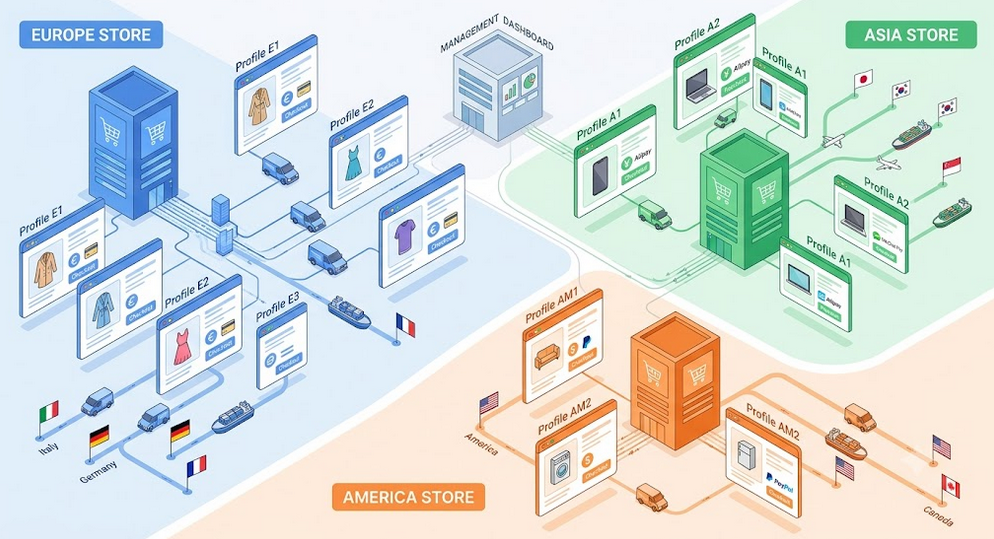
Modern e-commerce has evolved far beyond the traditional model of operating a single online store. Today, many entrepreneurs, agencies, aggregators, and marketplace professionals manage multiple storefronts across various platforms, product categories, and geographic regions. Diversification allows businesses to test new products, enter additional markets, separate brands, and reduce operational dependence on a single revenue source.
However, as online marketplaces continue investing in sophisticated risk-management and fraud-detection systems, managing multiple accounts has become increasingly complex. Major platforms evaluate a wide range of technical, behavioral, and network-level signals to identify relationships between accounts and detect potentially coordinated activity.
As a result, digital identity management has become an important operational consideration for businesses running multiple storefronts. Antidetect browsers have emerged as one of the technologies commonly used to create isolated browser environments and maintain separation between different account ecosystems.
The Growth of Multi-Store E-Commerce Strategies
Many successful sellers operate more than one store for legitimate business reasons.
Examples include:
- Managing different product categories.
- Separating premium and budget brands.
- Operating stores in multiple countries.
- Testing new product lines.
- Running localized marketing campaigns.
- Managing client stores within an agency structure.
- Creating dedicated storefronts for specific customer segments.
This approach is often referred to as multi-store management.
Multi-store management is the practice of operating several independent e-commerce properties while maintaining separate branding, customer experiences, marketing strategies, and operational workflows.
As businesses scale, maintaining clear separation between these environments becomes increasingly important.
Understanding Digital Identity in E-Commerce
Every interaction between a seller and an online platform creates a digital identity footprint.
A digital identity is a collection of technical and behavioral signals that collectively describe a user or device.
These signals may include:
- Browser fingerprint
- IP address
- Device characteristics
- Operating system
- Language settings
- Timezone configuration
- Network provider
- Login patterns
- Session history
- Cookie data
- Behavioral interactions
Modern marketplace security systems rarely evaluate a single signal in isolation.
Instead, they analyze relationships between multiple attributes to determine whether accounts appear independent or connected.
This process is commonly known as identity correlation.
What Is Identity Correlation?
Identity correlation is the practice of linking multiple accounts through shared technical characteristics.
Platforms may compare:
- Browser fingerprints
- Network infrastructure
- Session behavior
- Device identifiers
- Geolocation patterns
- Browser storage data
- Login histories
When enough similarities exist, accounts may become associated within a platform’s internal risk models.
For businesses operating multiple storefronts, maintaining clear separation between account environments is often considered a best practice for operational organization and risk management.
How Antidetect Browsers Create Isolated Environments
Anti-detect browsers are specialized browser environments designed to manage multiple independent browser profiles.
Each profile functions as a self-contained workspace with its own:
- Cookies
- Local storage
- Cache
- Browser fingerprint
- Network settings
- User-Agent configuration
- Device parameters
Instead of sharing one browser environment across all stores, users can assign a dedicated profile to each operation.
This concept is known as browser profile isolation.
Browser profile isolation helps ensure that activities performed within one profile remain separate from activities occurring in another profile.
Browser Fingerprinting and Marketplace Security
One of the most important technologies involved in account identification is browser fingerprinting.
Browser fingerprinting generates a probabilistic identifier using information exposed by the browser and operating system.
Common fingerprinting attributes include:
- Screen resolution
- Installed fonts
- Graphics hardware
- Canvas rendering output
- WebGL parameters
- Audio processing signatures
- Language settings
- Timezone information
When combined, these attributes can create a highly distinctive browser profile.
Advanced risk-assessment systems frequently use fingerprinting as one component of broader device intelligence frameworks.
Device Intelligence and Risk Scoring
Modern marketplaces increasingly rely on device intelligence systems.
Device intelligence combines:
- Browser fingerprint analysis
- Behavioral analytics
- Network reputation
- Device history
- Geolocation consistency
- Session metadata
These signals contribute to a risk score that helps platforms evaluate account activity.
Risk scoring models are designed to identify unusual patterns, inconsistencies, or potentially suspicious account relationships.
For example, if multiple stores consistently share the same browser fingerprint, IP address, and device characteristics, automated systems may classify those environments as related.
The Role of Proxy Infrastructure
A browser profile represents only one component of digital identity.
Network identity is equally important.
Many advanced browser management workflows utilize dedicated proxy infrastructure.
Common proxy categories include:
Residential Proxies
Residential proxies route traffic through IP addresses assigned to consumer internet connections.
ISP Proxies
ISP proxies combine the stability of datacenter infrastructure with IP ranges associated with internet service providers.
Mobile Proxies
Mobile proxies use mobile carrier networks and frequently rotate IP addresses.
Datacenter Proxies
Datacenter proxies offer high performance and scalability but may be easier for platforms to identify.
Selecting an appropriate proxy strategy often depends on operational requirements, geographic targeting needs, and workflow design.
Fingerprint Consistency and Environmental Coherence
A critical concept in browser identity management is consistency.
Platforms evaluate whether browser attributes appear logically connected.
Examples include:
- Timezone matching geographic location.
- Browser language matching regional preferences.
- Device characteristics aligning with operating system data.
- Network location matching account activity patterns.
This principle is commonly called environmental coherence.
Environmental coherence refers to the consistency between all signals that collectively form a digital identity.
Many experts consider coherence more important than simply modifying individual fingerprint parameters.
WebRTC and Information Leakage
Another important topic is WebRTC leakage.
WebRTC is a browser technology that enables real-time communication features.
Improperly configured environments may expose:
- Local IP addresses
- Network information
- Connection metadata
Preventing unintended information disclosure is an important component of browser environment management.
Many antidetect solutions include controls designed to manage WebRTC behavior and reduce information leakage.
Multi-Store Scaling Strategies
As businesses expand, operational complexity increases.
Large-scale sellers often focus on:
- Account segmentation
- Workflow standardization
- Identity management
- Team collaboration
- Geographic expansion
- Brand diversification
Dedicated browser profiles can help organize these workflows by providing clear operational boundaries between stores.
This structure becomes particularly valuable when teams manage dozens or even hundreds of storefronts simultaneously.
Educational Resources and Industry Knowledge
The technical concepts behind browser identity management can be difficult for new sellers to understand.
Resources such as antidetect.org help bridge the gap between theory and practical implementation by providing:
- Browser comparisons
- Technical guides
- Fingerprinting explanations
- Proxy-related educational content
- Security best practices
- Operational recommendations
By explaining concepts such as Canvas fingerprinting, WebGL analysis, device intelligence, identity correlation, and browser profile isolation, these resources help users make more informed decisions about browser management technologies.
The Future of Marketplace Operations
Marketplace ecosystems continue to evolve toward increasingly sophisticated detection technologies.
Machine-learning systems, behavioral analytics, device intelligence platforms, and risk-assessment models are becoming standard components of modern fraud-prevention infrastructure.
As these systems become more advanced, understanding digital identity management, browser fingerprinting, network reputation, and environmental consistency will become increasingly important for e-commerce professionals.
For organizations operating multiple storefronts, structured browser environments, profile isolation, and consistent digital identities represent important elements of scalable operational infrastructure.
Antidetect browsers are no longer viewed solely as browser customization tools. Instead, they are increasingly regarded as platforms for identity management, workflow separation, and operational organization in modern e-commerce ecosystems.
