
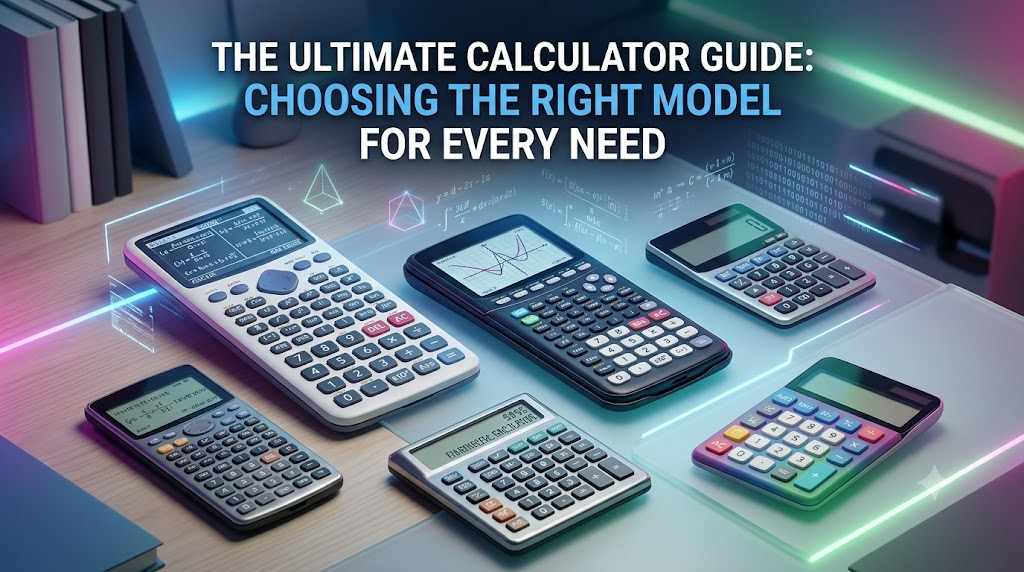
Calculators are indispensable tools for students, professionals, and anyone dealing with numbers regularly. Selecting the right calculator model is crucial in achieving efficiency and ease in computations, be it for basic arithmetic operations or advanced scientific calculations.
Understanding Different Types of Calculators
Calculators come in various types, each catering to specific tasks. Understanding these distinctions can significantly aid in choosing the right model for your needs.
Basic Calculators
Basic calculators are ideal for simple arithmetic calculations such as addition, subtraction, multiplication, and division. They often feature a straightforward interface with a limited number of buttons. These calculators are perfect for elementary students and for use in households or businesses that require simple computations.
Scientific Calculators
Scientific calculators are equipped to handle complex mathematical functions including trigonometry, logarithms, and exponentiation. They are essential for high school and college students enrolled in advanced mathematics courses. Their ability to perform a wide range of functions makes them indispensable for engineers and scientists.
Graphing Calculators
Graphing calculators go beyond the capabilities of scientific calculators by providing a visual representation of equations. They are particularly useful in subjects such as calculus and algebra, where graphing functions is an integral part of the curriculum. These calculators often come with a larger screen and the capability to plot multiple equations simultaneously.
Financial Calculators
Financial calculators are tailored for professionals in accounting, finance, and real estate. They are designed to perform time value of money calculations, including loans, investments, and annuities. These calculators provide functionalities that are crucial in making financial decisions and analyses.
Key Features to Consider
When choosing a calculator, various features should be considered to ensure it meets your specific needs. These features include display size, battery life, and auxiliary functions.
Display
The display size and clarity are important, especially for scientific and graphing calculators. A larger display allows for more information to be viewed simultaneously, which can be a significant advantage during complex calculations.
Power Source
Calculators typically use solar power, batteries, or a combination of both. Solar power can be beneficial for prolonged use without the frequent need for battery replacements. However, battery-powered calculators may offer more consistent performance in low-light conditions.
Additional Functions
Some models offer additional functions such as matrix calculations, statistical analysis, and programmability. These features can be highly beneficial for certain academic or professional tasks.
Making the Right Choice
Ultimately, the best calculator for you depends on your specific academic or professional needs. Students and professionals alike should evaluate the calculator’s capabilities against their requirements. Researching different models and their reviews can also provide valuable insights into their functionality and reliability.
Conclusion
With a wide array of calculators available, selecting the right model can significantly enhance productivity and ease day-to-day mathematical tasks. By considering the type of calculator, key features, and personal requirements, one can make an informed decision that aligns with their needs.
