
Only Strata’s regional service areas
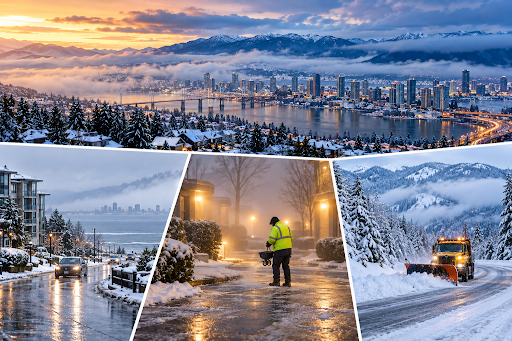
A weather map can make a large region look deceptively uniform.
One forecast may show the same storm icon across dozens of communities, yet the conditions experienced by individual properties can differ substantially. Snow may be accumulating at one site while another is receiving rain. A third property may have little fresh precipitation but still be dealing with overnight refreeze.
That is why Lower Mainland snow service zones should be understood operationally rather than simply geographically.
A useful service zone is not just a group of addresses. It reflects how quickly crews can move between properties, how conditions change along the route, which areas are likely to require repeat attention, and what resources need to be positioned before a storm develops.
Only Strata Snow Removal approaches regional coverage with strict capacity limits rather than assuming every additional property can simply be added to the same route.
That matters because winter response becomes less reliable when service territory expands faster than equipment, crews, material reserves, and travel time can support it.
Regional coverage only works when operational capacity is built around the differences inside the region.
Strata winter service for Abbotsford communities
Inland valley conditions introduce a different type of winter risk from properties closer to the immediate coast.
The issue is not simply whether more snow falls. Moisture, visibility, overnight cooling, cold-air behaviour, and surface temperature can combine in ways that make seemingly minor weather changes operationally important.
Fog Can Become a Surface Problem
Good valley fog freeze property management starts by recognizing that moisture can arrive without obvious precipitation.
Fog, damp pavement, residual meltwater, and high humidity can leave exposed surfaces carrying enough moisture for a later temperature decline to matter.
If surface temperatures drop below freezing, pedestrian routes, entrances, low areas, and internal roads can develop thin ice even when the property did not receive a major snowfall.
This makes inspection timing important.
A contractor that reacts only to snow depth may overlook a property whose main risk is moisture followed by overnight cooling.
Low Areas Can Hold Risk Longer
Terrain also affects what happens after precipitation.
Cold air can settle differently across lower areas, while drainage and shade influence which surfaces dry first. One section of a strata property may improve rapidly while another remains wet and vulnerable to refreeze.
That is why valley fog freeze property management should include known moisture zones, shaded surfaces, drainage paths, and early-morning access priorities rather than relying solely on a regional accumulation trigger.
Property-specific winter coverage for Mission strata properties
Elevation introduces another layer of complexity.
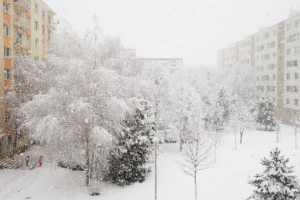
A short drive can cross enough vertical change for precipitation type, pavement condition, and snow retention to change noticeably. Rain at a lower point does not guarantee rain across an entire service route.
That is the logic behind rain-to-snow elevation transition planning.
Crews operating across changing terrain need to account for the possibility that conditions will not remain consistent between properties—or even across the same extended route.
A lower-elevation site may primarily require drainage awareness and ice control. A higher property can be dealing with accumulating wet snow at the same time. The equipment, material use, timing, and follow-up needs can therefore differ even though both properties are responding to the same regional weather system.
For strata contractors, this creates a dispatch problem as much as a weather problem.
Resources should be positioned according to expected site conditions rather than sent through a rigid sequence that assumes every stop will require the same type of work.
Effective rain-to-snow elevation transition planning allows dispatch decisions to follow the storm as conditions change.
One Storm Can Create Three Different Service Calls
Regional snow management becomes easier to understand when the same storm is viewed from the property level.
One site may need mechanical clearing.
Another may need targeted ice control.
A third may initially require no service but need inspection several hours later when temperatures fall.
Treating those sites identically wastes resources.
A successful regional winter operation therefore needs clear triggers at both levels: broad weather awareness and property-specific conditions.
This is also where Only Strata’s proactive dispatch becomes useful. Crews can be directed according to the type of condition developing rather than waiting for every property to cross one universal snowfall threshold.
GPS and photo service logs then provide a record of what crews encountered at individual locations.
Those records can gradually reveal patterns.
A property that repeatedly receives wetter snow may need different timing. Another may consistently require follow-up after daytime melting. A third may remain exposed to drifting even after the original storm has passed.
The regional map shows where properties are.
Service history explains how they behave.
The Route Map Is Not the Weather Map
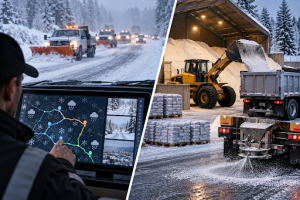
Distance is only one variable in winter route planning.
Travel Time Changes During the Event
A route that works efficiently in dry conditions may behave differently once snow begins accumulating.
Traffic slows. Grades become more difficult. Intersections back up. Equipment may spend longer at individual sites. Crews can also encounter changing precipitation while travelling between stops.
That means route capacity should include winter disruption rather than being calculated from normal driving time.
Only Strata’s strict capacity limits help protect against a common operational failure: selling more service than a storm route can realistically deliver.
Material Demand Is Regional Too
Ice-control demand can also vary across the same operating territory.
One zone may consume relatively little material during an event dominated by mechanical clearing. Another may require repeated treatment because moisture and temperature continue cycling around freezing.
Large salt reserves help provide resilience, but inventory alone is not enough.
Material has to be allocated where conditions actually justify it.
The objective is not identical treatment across every property. It is consistent service standards supported by locally appropriate decisions.
Regional Coverage Works Only When Local Differences Matter
A contractor can advertise a broad service territory and still operate as though every property experiences the same winter.
That is where regional scale becomes a weakness.
Strong Lower Mainland snow service zones should account for coastal influence, valley moisture, elevation, wind exposure, drainage, property layout, route travel time, and repeat-service requirements.
Only Strata Snow Removal combines that regional approach with a strata-only focus, proactive dispatch, GPS and photo documentation, substantial material reserves, reliable winter response, cancellation flexibility, and a damage repair guarantee.
Those features help support a broader operating principle: standardize the quality of service without pretending the conditions are standardized.
The same storm can demand plowing in one location, ice control in another, and monitoring somewhere else.
The correct response depends on the property.
That is why winter planning should begin with regional awareness but end with local decisions.
The Lower Mainland may appear as one area on the map.
Operationally, it is many winter environments sharing the same storm.
