
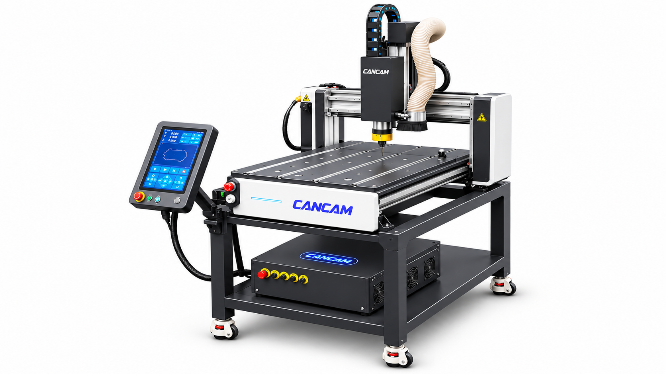
Photo courtesy of CanCam CNC Machines
Key Takeaways
- CNC routers can cut hardwood, MDF and plywood, but each material requires different tooling, cutting speeds and machining strategies for optimal results.
- Hardwood density and grain direction affect cutting resistance, chip evacuation, edge quality and the risk of tear-out or burning.
- MDF’s uniform composition makes it ideal for detailed profiles and repeatable cuts, although its abrasive properties accelerate tool wear.
- Effective dust extraction is especially important when cutting MDF because fine particles can accumulate around the cutting tool and interfere with vacuum hold-down systems.
- Plywood’s alternating grain directions and adhesive layers increase the risk of splintering and veneer breakout. Compression bits help produce cleaner edges on both faces.
- Workholding methods should account for material flatness, porosity and part size to prevent movement during machining.
- Tracking cutting time, material yield and finishing requirements helps woodworking businesses calculate the actual cost per usable part and produce more accurate quotes.
A CNC router can handle everything from intricate hardwood carvings to precision-cut plywood components and detailed MDF cabinet doors. That versatility is a major advantage for woodworking businesses producing different products or working with multiple materials. However, each material has its own characteristics that influence cutting speeds, tooling choices and the quality of the finished piece.
If your shop is looking to expand its capabilities, tools like CanCam’s wood CNC routers offer the flexibility to work across a wide range of woodworking applications. Knowing how hardwood, MDF and plywood respond to CNC cutting helps you choose the right approach for each job, maintain consistent quality and make the most of your equipment.
Hardwood Puts More Pressure on Tooling
Solid hardwood is usually the least forgiving of the three materials because density and grain direction vary from species to species. Hard maple, oak and walnut can place considerably more load on a cutting tool than softer woods, particularly during deep passes.
That makes chip evacuation especially important. If chips remain in the cut, heat builds quickly and can dull the bit or leave burn marks along the edge. Shops often respond with shallower passes, appropriate chip loads and tooling designed to clear waste efficiently.
Grain also changes how the material behaves. Cutting across grain can create tear-out around exposed edges, while climbing or conventional cutting strategies may produce different results depending on the part geometry. Small changes in toolpath strategy can therefore make a noticeable difference in finishing time.
MDF Is Consistent but Hard on Tools
MDF is almost the opposite of solid hardwood. There is no grain direction to work around, and it’s remarkably uniform from one sheet to the next. That consistency makes it excellent for cabinet doors, signage, jigs, prototypes and any job involving detailed profiles.
The trade-off is abrasion. MDF contains wood fibres combined with binders and resins, which can wear out cutting edges faster than many people expect. A dull bit will often leave fuzzy edges or require additional sanding, which is a problem on longer production runs.
Dust is another important factor. MDF machining produces extremely fine particles, which means effective extraction is essential for both cut quality and shop housekeeping. Poor dust removal can also interfere with vacuum hold-down systems and allow debris to accumulate around the tool.
Plywood Introduces Multiple Materials at Once
Plywood looks simple from the outside, but every sheet is a stack of alternating veneers bonded together with adhesive. The router is therefore cutting through changing grain directions and glue lines in the same pass.
That layered construction is what makes plywood strong, but it also creates the risk of splintering or veneer breakout. Compression bits are commonly used for through-cuts because their geometry pushes the top and bottom veneers toward the centre of the sheet, helping produce cleaner edges on both faces.
Sheet quality matters too. Higher-grade plywood tends to have more consistent internal layers, while lower-grade panels may contain voids that suddenly reduce resistance as the bit moves through the material. Those inconsistencies can affect edge quality and sometimes part stability.
Workholding Changes With the Material
Material choice also affects how reliably parts stay in place.
MDF is relatively flat and porous, which often makes it well suited to vacuum tables. Plywood can be less predictable because warped sheets or surface irregularities may reduce vacuum contact. Solid hardwood introduces another variable because individual boards can vary considerably in thickness and flatness.
For smaller parts, tabs, onion-skin passes or additional mechanical hold-down may be needed regardless of material. The goal is to keep the workpiece stable without creating extra finishing work after machining.
Price the Finished Part, Not Just the Material
Before quoting your next job, consider running a sample part and recording its actual cutting time, material yield and any finishing it needs. That gives you a more useful figure than the price of a board or sheet alone: the cost of each usable part.
A lower-priced material may turn out to be the more expensive choice for a particular design. Keep those results with your CNC programs so the next quote is based on what your shop has actually produced.
