
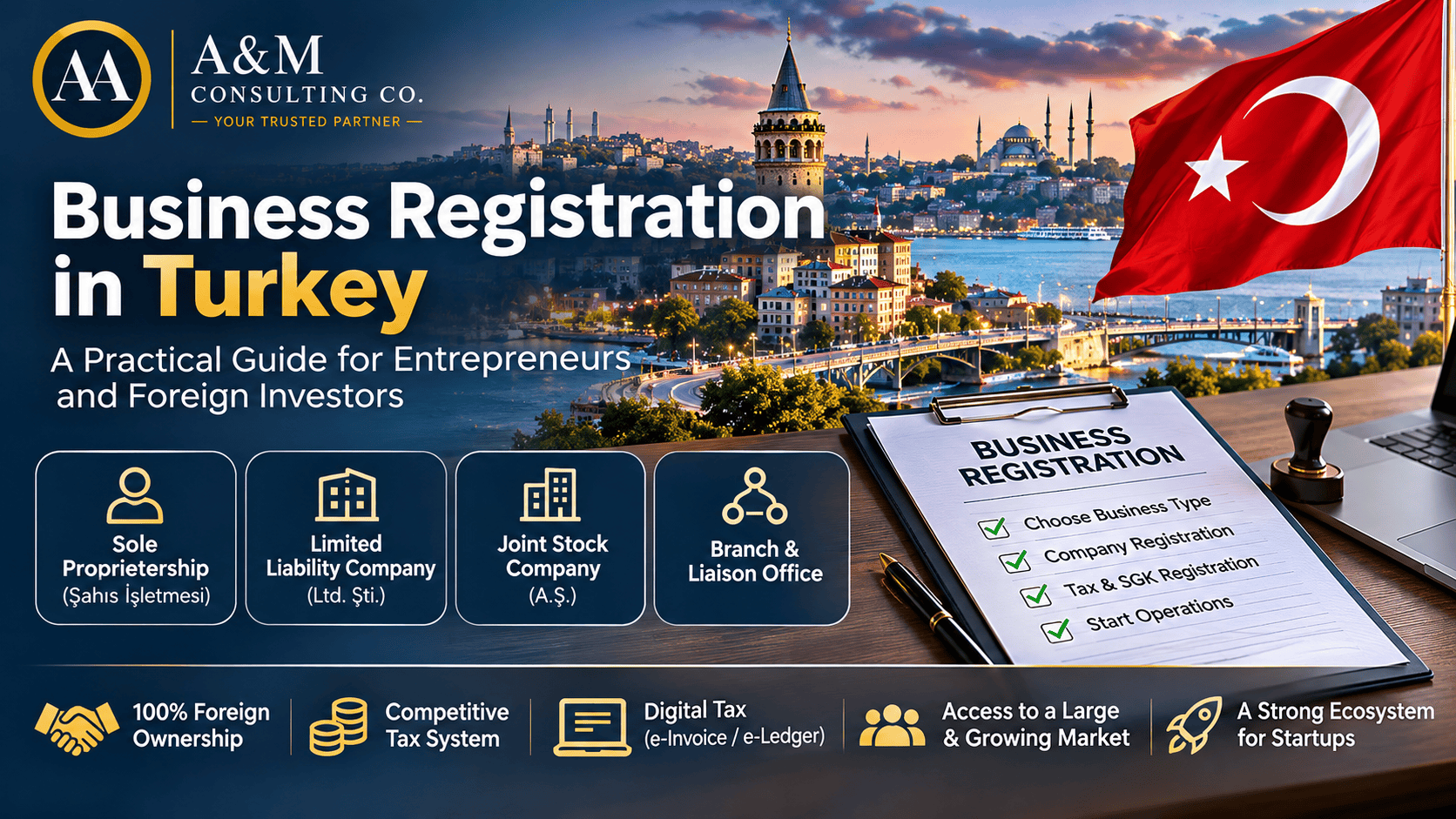
A Practical Guide for Entrepreneurs and Foreign Investors
Turkey offers entrepreneurs access to a large domestic market, an established industrial base, a skilled workforce and a strategic position between Europe, Asia and the Middle East. For international businesses, it can also serve as a regional base for sales, sourcing, manufacturing, technology, logistics and professional services.
Starting business operations in Turkey involves more than registering a company. The term “business registration” is commonly used to describe the broader process of establishing a legal presence, registering with the relevant authorities, obtaining any activity-specific permits, setting up tax and accounting systems, and meeting ongoing employment and regulatory obligations.
Company registration is one important part of this process: it creates the legal entity. Business registration and operational setup address the additional steps needed to conduct business lawfully and efficiently. This guide explains the main considerations for local entrepreneurs and foreign investors planning to establish a business in Turkey.
1. Determine the Right Legal Presence for Your Business
The first step is to identify how the business will operate in Turkey. The appropriate structure depends on the intended activities, ownership, liability, management, investment plans and whether the foreign business needs a separate Turkish legal entity.
A sole proprietorship is often the simplest and most accessible way for an individual entrepreneur to start a business in Turkey. Unlike an LLC or A.Ş., it is not a separate company incorporated under the Turkish Commercial Code. The business is carried on by an individual who is registered as a taxpayer and, where applicable, registered as a merchant with the relevant trade registry or professional body.
Key characteristics include:
- There is no statutory minimum share capital requirement.
- The business does not have a legal personality separate from its owner.
- The individual entrepreneur is generally personally liable for the business’s debts and obligations, subject to applicable legal rules.
- Business income is generally subject to personal income tax under the applicable progressive tax rates; VAT, withholding and other obligations may also apply depending on the activity and transactions.
- The owner may need to be registered with the Social Security Institution (SGK) as a self-employed insured person under Bağ-Kur (4/b), depending on their status and other insurance circumstances.
This structure is commonly considered by freelancers, consultants, individual service providers, small retailers and entrepreneurs who want to begin operating without establishing a separate corporate entity.
1.1. Sole Proprietorship (Individual Business)
Foreign nationals should obtain a separate assessment before choosing this structure. The ability to register as a taxpayer does not by itself grant the right to reside or work in Turkey; immigration, work permit and activity-specific requirements must be checked.
1.2. Limited Liability Company (Ltd. Şti.)
A Limited Liability Company is a widely used structure for small and medium-sized businesses, trading operations, service providers and many foreign-owned businesses. It may be established by one or more shareholders, and it is managed by one or more managers.
- Minimum share capital: TRY 50,000.
- Cash capital commitments may generally be paid within 24 months following registration; the 25% pre-registration deposit requirement applicable to joint stock companies does not apply to limited liability companies.
- The company has a separate legal personality and its own tax and accounting obligations.
- Share transfers are subject to statutory formalities and may require general assembly approval, depending on the articles of association.
1.3. Joint Stock Company (A.Ş.)
A Joint Stock Company is often considered by businesses planning to raise external investment, establish a more sophisticated shareholding structure, or prepare for larger-scale operations. It is managed by a board of directors.
- Minimum share capital: TRY 250,000.
- At least 25% of the cash share capital must generally be paid before registration; the balance is payable within 24 months.
- Shares are generally more transferable than LLC capital shares, subject to statutory and articles-of-association restrictions.
- Corporate governance and board procedures should be considered when planning the company’s ongoing administration.
1.4. Branch Office
A foreign company may establish a branch in Turkey, subject to the applicable registration and regulatory requirements. A branch is not a separate legal entity from its foreign head office. The parent company remains responsible for the branch’s obligations. This structure may be appropriate where the foreign company wants to conduct business in Turkey directly rather than incorporate a subsidiary.
1.5. Liaison Office
A liaison office may be suitable for a foreign company that wants to conduct non-commercial activities such as market research, representation or communication with business partners. A liaison office cannot generate revenue or conduct commercial activities in Turkey and requires permission from the Ministry of Industry and Technology. It is therefore not a substitute for a company or branch where commercial transactions are intended.
1.6. Which Structure Should You Choose?
A sole proprietorship is often the most straightforward option for an individual carrying on business independently, particularly where limited liability or an investor-ready share structure is not required. An LLC or A.Ş. should be considered where the founders need a separate legal entity, limited liability framework or a structure for multiple shareholders and investment.
There is no universally best structure. An LLC may be appropriate for a closely held operating business, while an A.Ş. may be better suited to investment transactions or a more flexible share structure. A branch may suit an existing foreign company expanding directly into Turkey, while a liaison office is limited to non-commercial activities. The decision should be based on the actual business model and future plans, not only the initial setup cost.
2. Define the Business Activities and Check Licensing Requirements
Before registering, founders should describe the activities the business will carry out in Turkey. The selected activities are reflected in the company’s constitutional documents and relevant registration records, and they help determine applicable NACE activity codes, tax treatment and potential licensing obligations.
Many ordinary commercial, consulting, software and trading activities can be carried out through a standard company. However, certain sectors are regulated and may require a licence, authorisation, notification or approval from a competent authority.
Examples include banking, payment services, electronic money, insurance, healthcare, education, telecommunications, energy and certain transportation activities. For example, incorporating a company does not by itself authorise a fintech business to provide regulated payment or electronic money services.
The regulatory analysis should therefore take place before operations begin, and ideally before the company structure and business activities are finalised.
3. Select the Registered Address and Prepare the Founders’ Information
A Turkish company must have a registered address in Turkey. Depending on the business model and applicable requirements, this may be a commercial office, a suitable serviced office or a virtual office address. The address arrangement should be supported by appropriate documentation and should be suitable for the company’s actual activities and any relevant licensing conditions.
The founders should also agree on the following information:
- Proposed company name and legal structure.
- Registered office address.
- Shareholders, ownership percentages and capital commitments.
- Business activities and relevant NACE codes.
- Managers or board members and their representation powers.
- Company duration and other mandatory provisions.
- Any intended governance, share transfer or shareholder arrangements.
For businesses with multiple founders, it is prudent to address decision-making, intellectual property ownership, funding commitments, founder departures, share transfers and deadlock situations. These matters may be addressed in the articles of association and, where appropriate, a separate shareholders’ agreement.
4. Prepare the Incorporation Documents
For a Turkish LLC or A.Ş., the articles of association are prepared electronically through MERSİS (Central Registry Record System). The document sets out the company’s legal name, registered office, business purpose and activities, capital, shareholders, management and other statutory provisions.
Foreign individuals and foreign legal entities may generally establish and own Turkish companies, subject to sector-specific restrictions. A Turkish partner is not generally required solely because a shareholder is foreign.
4.1. Documents for Foreign Individual Shareholders
Depending on the circumstances and the relevant Trade Registry Directorate’s requirements, foreign individual shareholders may need to provide:
- A valid passport and the required Turkish translation and notarised copy.
- A Turkish tax identification number or potential tax identification number, as applicable.
- A power of attorney if a representative will complete the procedures in Turkey.
4.2. Documents for Foreign Corporate Shareholders
Where a foreign legal entity will become a shareholder, the required documents may include:
- A current certificate of incorporation, registry extract or certificate of activity showing the company’s current status and authorised signatories.
- A resolution of the competent corporate body approving the Turkish investment and incorporation.
- Details of the person authorised to represent the foreign corporate shareholder.
- A power of attorney, if the process will be handled by a representative.
Documents issued abroad may need to be apostilled or legalised, depending on the country of issue and applicable international arrangements. They may also need to be translated into Turkish and notarised. The exact requirements should be confirmed before documents are sent to Turkey.
5. Register the Company Through MERSİS and the Trade Registry
The establishment process for a Turkish LLC or A.Ş. is generally carried out through MERSİS and the competent Trade Registry Directorate. The principal stages are:
- Determine the legal structure, shareholders, capital, registered address and business activities.
- Prepare the articles of association and related information through MERSİS.
- Complete the required signature verification and supporting document procedures.
- Complete the applicable capital payment formalities and statutory establishment payments.
- Submit the incorporation application and supporting documents to the competent Trade Registry Directorate.
- Respond to any requests for correction or additional documentation.
- Following approval, the company is registered and the registration is announced in the Turkish Trade Registry Gazette.
The company acquires legal personality upon registration. The exact documents and processing time can vary depending on the company type, shareholder structure, foreign documents and the relevant Trade Registry Directorate.
6. Understand the Capital and Establishment Payment Requirements
The statutory minimum capital depends on the chosen company type. As a general rule, the minimum is TRY 50,000 for an LLC and TRY 250,000 for an A.Ş. A joint stock company using the registered capital system may be subject to a higher initial capital threshold.
For an LLC, the subscribed cash capital may generally be paid within 24 months following registration. For an A.Ş., at least 25% of the subscribed cash capital must generally be paid before registration, with the remaining amount payable within 24 months. Contributions in kind are subject to additional valuation and registration procedures.
A payment corresponding to 0.04% of the company’s capital is generally made to the Competition Authority fund as part of the establishment process. Other costs may include Trade Registry and Chamber of Commerce fees, notary charges, translations, address services and professional fees. These costs vary according to the transaction and should be confirmed before incorporation.
7. Complete Tax Registration and Set Up Accounting
After registration, the company must ensure that its tax registration and accounting systems are properly established. The Trade Registry generally notifies the relevant tax office of the incorporation, but the company should verify its tax records and complete any required follow-up procedures.
7.1. Main Tax Obligations
Depending on its activities and transactions, a Turkish business may be subject to:
- Corporate income tax on taxable corporate profits.
- Value Added Tax (VAT/KDV) on taxable supplies of goods and services.
- Withholding tax on specified payments, where applicable.
- Stamp tax on documents falling within the scope of the Stamp Tax Law.
- Other sector-specific taxes, duties or reporting obligations where relevant.
The applicable tax treatment depends on the company’s activity, transaction type, customer and supplier locations, invoicing arrangements and any available exemptions. Businesses with cross-border operations should also assess permanent establishment, transfer pricing, withholding tax and double taxation treaty considerations where relevant.
7.2. Bookkeeping and Statutory Records
Turkish companies must maintain accounting records and statutory books in accordance with Turkish legislation. The company should establish a suitable accounting process from the beginning, including document collection, invoice issuance, expense documentation, bank reconciliations and periodic tax reporting.
7.3. E-Invoice, E-Archive and E-Ledger
Businesses should assess whether they fall within the scope of mandatory electronic document and ledger systems, including e-Fatura, e-Arşiv and e-Defter. The obligation may depend on turnover thresholds, sector, activity and other criteria. Not every newly established business has identical e-document obligations from its first day.
8. Register as an Employer and Comply with Labour and Social Security Rules
If the business hires employees, it must complete the relevant employer registration and employee notifications with the Social Security Institution (SGK). Employers are responsible for employment documentation, payroll calculations, social security contributions, income tax withholding and statutory declarations.
Before hiring, businesses should consider employment contracts, working time, leave, occupational health and safety, workplace policies and any sector-specific employment requirements. Payroll and SGK compliance should be integrated into the company’s monthly accounting and reporting calendar.
9. Open a Corporate Bank Account
A Turkish business generally needs a corporate bank account to receive customer payments, pay suppliers, manage capital and settle tax and payroll liabilities. Banks conduct their own customer due diligence and may request:
- Trade Registry Gazette and current company registry information.
- Articles of association and tax registration details.
- Identification documents of shareholders, directors and authorised signatories.
- Information about beneficial owners, business activities and expected transaction flows.
- Evidence concerning the source of funds and commercial purpose of the account.
Bank account opening is subject to the bank’s internal risk assessment, KYC procedures and approval. Incorporation does not guarantee that a particular bank will open an account. Foreign directors or shareholders may be asked to provide additional documents or attend in person, depending on the bank.
For a detailed explanation about opening corporate bank account in Turkey, see our dedicated guide: Corporate Bank Account Opening in Turkey
10. Obtain Work Permits and Other Authorisations Where Necessary
Company ownership does not automatically grant a foreign shareholder or director the right to work or reside in Turkey. Foreign nationals who will work in Turkey should assess the applicable work permit requirements separately. The criteria may depend on the person’s role, shareholding, company structure and the rules in force at the time of application.
Likewise, a company must obtain any activity-specific licence or permit before carrying out regulated operations. The incorporation process and the operational authorisation process are separate legal steps.
11. Consider Incentives and Special Business Locations
Depending on the business activity and eligibility conditions, companies may explore investment incentive certificates, Technology Development Zones (Technoparks), organised industrial zones, free zones, R&D support and programmes administered by public institutions.
These mechanisms may provide tax, social security, customs or other advantages, but the benefits are conditional. Each programme has its own application, activity, location, employment, investment and reporting requirements. A company should not assume that it qualifies automatically because it operates in a particular sector or has been newly incorporated.
12. Ongoing Compliance After Business Registration
Business registration is not a one-time administrative task. A Turkish business must continue to meet its corporate, tax, accounting, employment and regulatory obligations throughout its operations.
Depending on the company’s structure and activities, ongoing compliance may include:
- Maintaining statutory books and accounting records.
- Preparing and submitting periodic tax returns and declarations.
- Issuing invoices in the required format and retaining supporting documentation.
- Calculating payroll and submitting SGK declarations on time.
- Holding required general assembly meetings and preparing corporate resolutions.
- Updating Trade Registry records when registered company information changes.
- Maintaining licences, permits and sector-specific registrations.
- Monitoring changes in tax, employment and commercial legislation.
A compliance calendar and clear allocation of responsibilities between management, finance staff and external advisers can help reduce missed deadlines and administrative risks.
13. Common Mistakes When Establishing a Business in Turkey
- Choosing a legal structure without considering the business model, liability, investment plans and future share transfers.
- Treating company incorporation as if it automatically authorises every intended business activity.
- Submitting foreign documents without checking apostille, legalisation, translation and notarisation requirements.
- Selecting a registered address that is unsuitable for the company’s activity or licensing requirements.
- Underestimating banking KYC procedures and assuming that an account opening is guaranteed.
- Delaying accounting, tax, e-invoice or payroll setup until after the first transactions or employees.
- Assuming that foreign company ownership automatically provides residence or work rights.
- Relying on incentives without checking the eligibility and application conditions.
Planning these matters before launch can help avoid delays, unexpected costs and compliance issues.
14. How A&M Consulting Co. Can Support Your Business in Turkey
A&M Consulting Co. supports foreign investors, entrepreneurs and international businesses establishing and operating in Turkey. Our approach covers both the legal and administrative setup of the business and the ongoing accounting, tax and employment compliance required after registration.
Depending on the client’s needs, our services may include:
- Company structure assessment and incorporation coordination.
- Preparation and coordination of MERSİS and Trade Registry documentation.
- Support with foreign shareholder documents, powers of attorney and translations.
- Registered address and virtual office coordination.
- Tax registration and post-incorporation procedures.
- Accounting, bookkeeping and tax compliance.
- Payroll and Social Security (SGK) services.
- E-Invoice, E-Ledger and electronic compliance setup.
- Work permit application support and corporate changes.
- Ongoing business and tax advisory services.
For a detailed explanation of the legal incorporation process and the requirements for establishing a Turkish company, see our dedicated guide: Business Registration in Turkey
Conclusion
Establishing a business in Turkey requires a coordinated approach to legal structure, company incorporation, tax registration, accounting, banking, employment and any activity-specific permits. Company registration creates the legal entity, while the broader business registration and operational setup process ensures that the business is ready to trade and meet its continuing obligations.
For foreign investors, early planning is particularly important because overseas documentation, banking due diligence, work permit considerations and sector-specific approvals can affect the overall timeline. By selecting an appropriate structure and preparing the post-registration compliance framework in advance, entrepreneurs can build a sound foundation for operating and growing their business in Turkey.
Frequently Asked Questions
Can a foreigner establish and own a company in Turkey?
As a general rule, foreign individuals and foreign legal entities may establish and own Turkish companies, including with 100% foreign ownership. Sector-specific restrictions and licensing rules should be checked for the intended activity.
What is the minimum capital for a company in Turkey?
The general minimum share capital is TRY 50,000 for a Limited Liability Company and TRY 250,000 for a Joint Stock Company. Different rules may apply to certain company types, registered capital systems or regulated sectors.
Can I register a business in Turkey without travelling there?
Some incorporation procedures can be handled through an authorised representative under a properly issued power of attorney. Foreign documents may need apostille or legalisation and Turkish translation. Banking and identity verification requirements may still require additional steps or personal attendance.
Does company registration automatically open a bank account?
No. Banks carry out separate KYC and risk assessments. A registered company may apply for a corporate bank account, but approval is subject to the bank’s internal procedures.
Does owning a Turkish company give me a work permit?
No. Company ownership does not automatically grant a foreign shareholder or director a work permit or residence right. Eligibility must be assessed separately under the applicable rules.
What is the difference between company registration and business registration?
Company registration is the legal process of incorporating a company and recording it with the Trade Registry. Business registration is often used more broadly to describe the steps required to establish and operate a business, including tax, social security, licensing, banking and other administrative registrations.
How long does it take to register a business in Turkey?
The Trade Registry stage can be completed quickly once the documents are complete and accepted. The overall timeline may be longer where foreign documents, translations, bank procedures, licences or regulatory approvals are involved. A reliable estimate requires reviewing the specific business and shareholder structure.
Disclaimer: This article is provided for general informational purposes only and does not constitute legal, tax or investment advice. Capital requirements, licensing rules, tax obligations and incentive conditions may change. Requirements should be confirmed for each specific business and transaction.
