
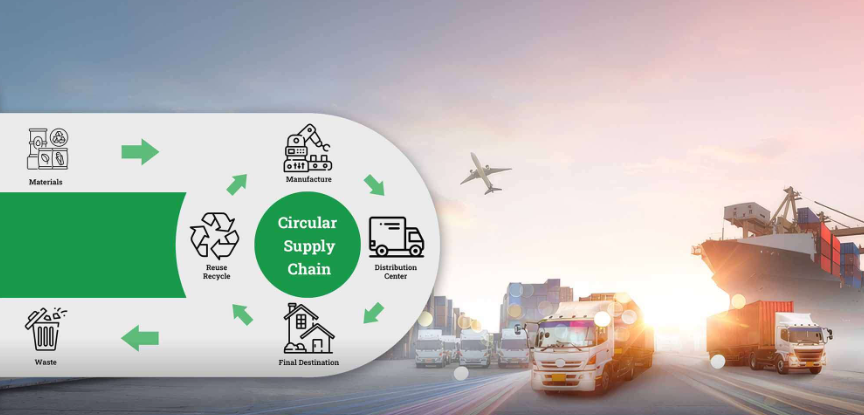
As businesses become more sustainable, Circular Supply Chains will be critical for reducing waste and maximising resource efficiency. Rather than following the traditional linear “take, make and dispose of” Supply Chain model, Circular Supply Chains break this model down into the steps of reuse, recycling, and reintroduction into the production cycle. Technology will be needed to create transparency and traceability of each step throughout the Supply Chain. Banyan Nation is a good example of using digital platforms, advanced recycling methods, and intelligence to create a dependable resource loop through waste management. By combining technology with sustainable practices, businesses can develop responsible supply chains that are accountable, perform more efficiently, and contribute to a sustainable Global Economy.
Circular Supply Chain Concept
The Circular Supply Chain Concept is gaining popularity with many of today’s companies interested in implementing sustainable business practices as a means of decreasing waste/extend product life cycles. The circular design of the supply chain fosters the reuse of materials through repair and, if applicable, their recycling and return to the production process, rather than discarding them at the end of life.
Traditional linear supply chains extract raw materials, produce products from them, and eventually dispose of them when used up. Conversely, circular supply chains are designed to keep resources in circulation as long as possible. By doing this, we not only reduce our environmental impact but also become more efficient with resources and build stronger businesses that can withstand future challenges.
Technology is a crucial factor for achieving this change because technology provides visibility and traceability of materials within supply chains.
Importance of Traceability and Transparency
Traceability and transparency are two critical pieces in the success of Circular Supply Chains. Without an effective tracking mechanism, it is nearly impossible to verify material use. With technology, a company can track the material from collection through its recycling or manufacturing process and be held accountable for everything that happens to it while in its possession.
Transparency is important for the following reasons:
- To ensure that recyclable material is sourced in a responsible way.
- To be able to track how waste was collected and recycled.
- To validate the sustainability claims of brands.
- To support government compliance with environmental regulations.
- To increase consumer trust in recycled products.
Real-time tracking enables the organisation to verify that materials are recycled, so they can be reused in the manufacturing process rather than lost to the waste stream.
How Digital Platforms are Changing Circular Supply Chains
Digital platforms are a key enabler of efficient circular supply chains by connecting multiple stakeholders, including collectors, recyclers, manufacturers, and brand owners. Organisations can use internet technologies to provide a platform for tracking material flow, collecting supply chain performance data, and enhancing recycling efficiency. Access to real-time information regarding the location of recyclable materials can be provided.
Digital technologies can be used by organisations to:
• Improve their decision-making processes regarding recycling activities, using data and analytics.
• Incorporate informal waste collectors in their recycling program.
• Increase the level of communication and collaboration between suppliers and manufacturers.
Digital Platforms will provide all organisations in the supply chain with timely, accurate information, enabling them to make informed decisions.
The Role of Data Intelligence in Supply Chain Transparency
Data intelligence has changed the way that Circular Supply Chain Businesses do business. Businesses are now able to gather and analyse data from their supply chain, which helps to identify where the “waste” is within the supply chain, improve their recycling operations and increase their overall material recovery rate. Data platforms enable companies to map their supply chains and track how products/materials move across different regions of the world.
Benefits to a data-driven circular supply chain include:
- More accurate predictions regarding the availability of recyclable materials.
- Identification of waste-producing areas within the supply chain.
- Increased efficiency in recycling operations.
- Increased accountability between supply chain partners.
By utilising analytics and data platforms, companies can foster more reliable and therefore more efficient recycling ecosystems.
Waste Collection Networks Supported by Technology
One of the main challenges in building efficient Circular Supply Chains is establishing waste collection networks. In many areas, waste collection is conducted by the informal sector without proper structure. Technology can help connect these collectors to official supply chains by providing digital tools to identify, train, and communicate with them.
There are many different technological solutions that can be used to accomplish this objective:
- Mobile Applications can connect collectors with recycling companies.
- Digital Mapping Tools can show all of the different waste collection areas.
- Training platforms can help collectors to learn how to sort properly.
- Digital Payment Systems can provide fair payments to all collectors.
These innovations can transform fragmented or informal waste networks into orderly, traceable supply chains.
Innovative Recycling Technology Supporting Circular Supply Chain
Innovation in recycling processes is extremely vital to support Circular Supply Chains as a further technological advancement, with modern recycling technologies able to separate impurities and convert waste materials into high-quality, consistent raw materials.
Many current innovations in Advanced Recycling Systems enable us to process complex plastic waste into materials that meet typical industrial standards.
Many of these innovative technologies include:
- Automated sorting systems to separate recyclables.
- Advanced washing systems to remove impurities from plastics.
- Advanced chemical recycling methods to recover raw polymer materials.
- A I-enabled sorting technology to improve the efficiency of sorting recyclables.
These recycling technologies produce high-quality recycled materials compatible with typical industrial manufacturing processes.
The Future of Technology in Circular Supply Chains
The continued evolution of technology will greatly impact how Circular Supply Chains evolve. Technologies that are growing in use today include Emerging Technologies such as Blockchain, Artificial Intelligence, and Machine Learning.
Future technologies will include:
- Optimising Supply Chains using Artificial Intelligence.
- Automated Recycling Facilities.
- Smart Packaging providing Recycling Information.
- Digital Marketplaces for Recycled Materials are available globally.
These technologies are expected to accelerate the transition to a Circular Economy and enable companies to operate more sustainably.
Challenges with Circular Supply Chains
Although implementing Circular Supply Chains offers many benefits, organisations can encounter obstacles.
Some businesses struggle with:
- Limited, reliable waste collection systems
- Insufficient infrastructure for efficient recycling on an industrial scale.
- Difficulty integrating informal economies into organised supply chain structures.
- Significant initial investment in technological platforms.
Despite technological progress accelerating and sustainability becoming a more serious global issue, these challenges continue to be addressed.
Final Thought
The changing nature of technologies is disrupting circular supply chains by delivering to companies (to the greatest degree possible) greater levels of visibility and accountability. Digital platforms, traceability technologies, and advanced recycling techniques enable companies to track their materials, improve recycling efficiency, and ensure responsible resource use. This new way of doing business not only reduces the environmental impact of operations but also enhances supply chain resilience and helps companies comply with sustainability regulations. Companies that use technology-based circular supply chains are more likely to succeed in environments with limited resources. Banyan Nation exemplifies how to create scalable circular ecosystems through technology, data intelligence, and sustainability. As technology continues to advance, it will remain the primary enabler of sustainable, transparent supply chains.
