
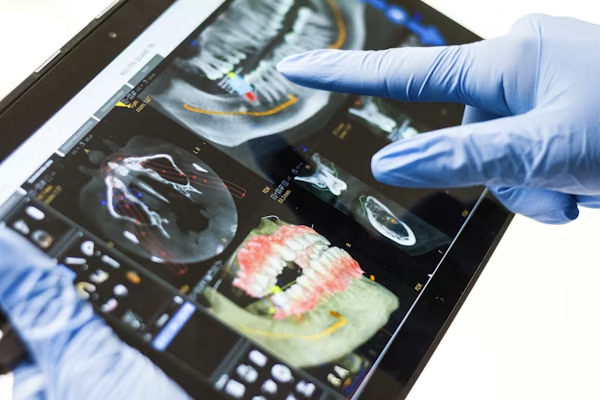
Missing a tooth changes more than your smile. It shifts how you eat, how you speak, and how comfortable you feel in everyday situations. Most people adapt quietly, avoiding certain food items, covering their mouth when they laugh, or simply learning to live with the gap between their teeth. That slow adjustment chips away at daily life in ways that are easy to minimize but hard to ignore.
People try to manage. They rotate through softer food options, smile with their lips closed in photos, and quietly stop doing things that once felt effortless. Dental implants address the problem at its root, quite literally, by replacing the missing tooth structure with a titanium post anchored directly into the jawbone. That foundation supports a crown that looks, feels, and functions like a natural tooth, restoring what was lost rather than working around it.
The Hidden Damage a Gap Leaves Behind
Bone Loss That Starts Immediately: The jawbone relies on chewing pressure to maintain its density. Once a tooth is missing, that section of bone stops receiving stimulation, and oral bone resorption begins gradually. Most people never notice until adjacent teeth start shifting or the jaw begins to look sunken. By the time visible changes appear, the process has already been running quietly for months or even years.
A Bite That Shifts Over Time: Neighboring teeth don’t stay put when a gap opens nearby. They tilt and drift toward the empty space over months, throwing off bite alignment in ways that create uneven pressure across the jaw. That misalignment often leads to tension in the jaw joint, difficulty chewing on one side, and in some cases, persistent facial discomfort that seems unrelated to the original missing tooth.
Consequences That Compound Year After Year: One missing tooth rarely stays a single, contained problem. Bone shrinks, teeth shift, neighboring teeth wear faster, and gum tissue changes shape around the gap. Patients who delay replacement often find themselves facing more extensive dental work years down the line, work that far exceeds what a timely implant would have cost or required in the first place.
What the Body Does Once an Implant Is in Place
A Bond That Makes It Feel Like Your Own: After the implant post is placed, the surrounding bone begins growing around it through a process called osseointegration. Over several months, the implant fuses with the jaw and becomes structurally part of it. The result feels different from any removable replacement. Patients consistently describe it as simply forgetting the implant is there, which is perhaps the most honest measure of how natural it becomes.
Confidence That Returns Without Effort: Confidence doesn’t announce itself. It shows up in small moments: ordering food without scanning for what’s safe to chew, speaking in a meeting without self-consciousness, laughing without covering your mouth. Patients who’ve lived with a gap for years often describe these changes as the part of recovery they didn’t anticipate. The tooth is replaced, but what returns alongside it is a quieter, more comfortable version of daily life.
Mental Energy That Goes Elsewhere: Managing a gap takes more focus than people realize until it’s gone. Patients who transition to implants often comment on how much mental space frees up once they stop planning around the limitation. Meals become less calculated. Social situations feel less managed. That cognitive relief, while hard to quantify, is one of the most consistently reported benefits in the years following the procedure.
Eating and Speaking Like Nothing Was Ever Lost
Food Choices Come Back Fully: Implants bear chewing force the way natural teeth do, which means patients can return to foods they had quietly written off. Raw vegetables, crusty bread, meat on the bone, foods that dentures or gaps made difficult or uncomfortable, all become manageable again. Meals stop being a workaround and start being something to enjoy without calculation or discomfort.
Here is what patients most commonly report in the months and years after full recovery:
- Biting into firm or crunchy foods no longer requires avoidance or adjustment.
- Speech clarity improves once teeth are stable and properly spaced in the mouth.
- The habit of covering the mouth or smiling with lips closed disappears gradually.
- Mealtime with family or colleagues feels relaxed rather than something to manage.
- Jawbone integrity is preserved for as long as the implant remains in place.
- Daily maintenance simplifies to regular brushing and flossing with no adhesives.
Speech Normalizes Without Practice: Gaps and ill-fitting dentures change how certain sounds are produced without the speaker fully realizing it. The tongue compensates, word shapes shift slightly, and some patients develop a subtle hesitation when speaking. Implants restore the structural support the tongue relies on. Most patients find their speech returns to its natural pattern within weeks of healing, without any deliberate effort to relearn it.
The Investment That Keeps Returning Value
Ongoing Costs That Simply Stop: Dentures require relining as the jaw changes shape. Bridges eventually wear or break and need replacing. Adhesives, cleaning solutions, and replacement hardware accumulate into real costs over a decade. Implants, maintained with standard oral hygiene, are designed to last a lifetime. For most patients, the upfront cost evens out within a few years, and the benefit continues long after that point.
Structural Protection for the Whole Mouth: Implants do more than fill a gap visually. They preserve alveolar bone volume, hold neighboring teeth in their correct positions, and distribute chewing forces evenly across the jaw. Patients who choose implants early often avoid a cascade of secondary dental problems that tend to follow years of leaving a gap untreated. The implant protects more than the space it occupies.
The Smile That Still Works Exactly the Same Years From Now
An implant placed today continues functioning the same way a decade from now. No relining, no soaking, no periodic replacement. The jawbone stays stimulated, neighboring teeth hold position, and gum tissue remains stable around a structure the body has accepted as its own. Living around a gap doesn’t have to be the long-term plan. Book a consultation today and find out what a permanent solution can do for your comfort, your bite, and your confidence going forward.
