

How Snow Contractors Should Communicate Before, During, and After a Storm: Silence Creates More WorkWhen Silence Turns Into a Dispatch Problem
Snow contractors often think customer communication is separate from field operations. During a storm, it is part of the operation.
When clients do not know whether a route has activated, when a crew is expected, or whether a return visit is planned, they start calling. Dispatchers then spend valuable time answering questions instead of coordinating crews.
For Snow Removal Expert in Canada, this is one reason operational reliability needs communication behind it. Fast clearing, 24/7 availability, modern equipment, safety-focused ice control, scheduled plans, and transparent pricing are easier for clients to understand when service status is communicated clearly.
The goal is not to send constant messages. It is to send the right message when the customer’s information needs change.
A useful storm workflow has six stages: forecast monitoring, activation, arrival expectations, active-service exceptions, completion confirmation, and post-event follow-up.
Build the Pre-Storm Communication Workflow
A snow-removal business guide from Snow Removal Expert is especially relevant for newer operators because communication standards should be built before the route grows. A contractor with five accounts can rely on memory; a contractor with fifty cannot.
Send a Forecast Message Without Overpromising
The first message should tell clients that weather is being monitored and explain what could activate service.
Do not convert a forecast into a guarantee too early. Environment and Climate Change Canada distinguishes between Watches, Advisories, and Warnings based on severity, timing, and required action. Warnings are often issued roughly 6 to 24 hours in advance, while conditions can still evolve.
Contractors should communicate the same uncertainty honestly.
A forecast notice might confirm the expected weather window, remind clients of their service trigger, and identify any preparation required, such as removing vehicles from priority areas.
Confirm When the Route Activates
The activation message should be operational rather than meteorological.
Tell the client that the service threshold has been reached or that the route has been activated based on conditions. Confirm the main service window and any known priority sequence.
This prevents a common problem: customers seeing snow outside and assuming a truck should already be at their property.
The Fastest Way to Lose Trust Is a Bad ETA
Clients like exact arrival times. Snowstorms rarely do.
Travel speed changes. Accumulation increases. A property takes longer than expected. Municipal plows create new windrows. Ice conditions require additional treatment.
Promising “we will be there at 4:15 a.m.” can create unnecessary failure when a realistic service window would have been accurate.
Use ranges whenever conditions remain dynamic. “Expected between 4:00 and 6:00 a.m.” is more useful than a precise time the dispatcher cannot control.
This is where a broader professional snow and ice service model benefits from organized dispatch. Contractors should know the difference between an internal route estimate and a customer-facing commitment.
During prolonged events, update clients only when the expected window changes materially.
The message should answer three questions: Has the property been scheduled? Has the expected timing changed? Does the client need to do anything?
That is enough information for most accounts.
Report Exceptions While They Can Still Be Fixed
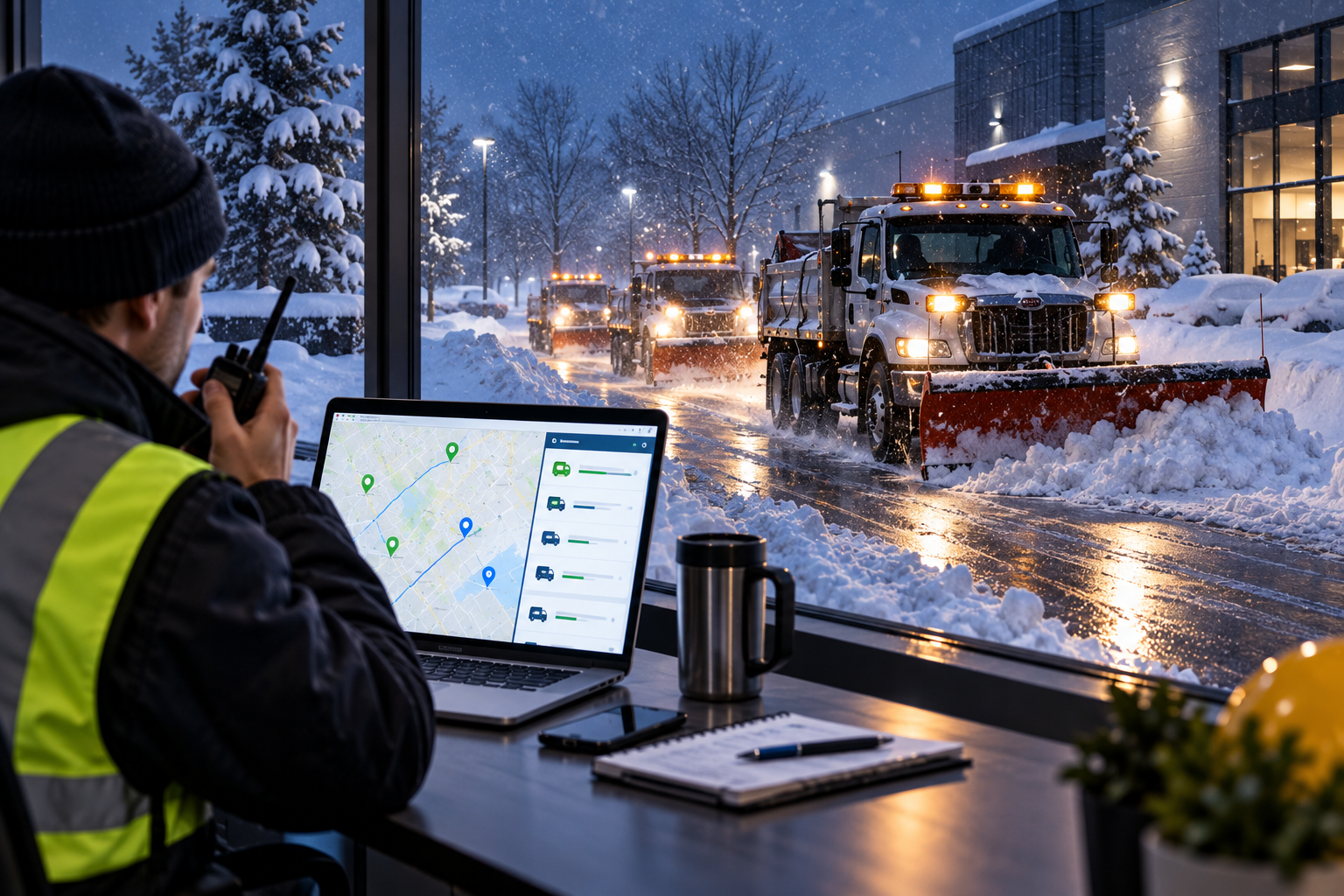
Storm communication becomes most valuable when something prevents the normal scope from being completed.
Separate Delay From Obstruction
A delay means the contractor still expects to perform the planned service but later than anticipated.
An obstruction means part of the work cannot currently be completed. Parked vehicles, locked gates, active loading operations, inaccessible snow-storage areas, construction materials, or equipment left in a clearing zone are examples.
Those situations should not wait until the final invoice.
Notify the customer while there is still time to solve them.
Document What Changed
Use brief notes and photos when conditions differ from the expected scope.
A photo of blocked parking stalls, a gate that could not be opened, or a loading area occupied by trailers creates useful context for both the client and the dispatcher.
Photos should support the service record, not replace communication. A customer should not have to interpret an unexplained image.
A strong exception note says what happened, what work was affected, what action was taken, and whether another visit is required.
That clarity also supports transparent pricing if additional work falls outside the original scope.
Completion Is a Message, Not a Truck Leaving
A contractor may consider the job complete when the equipment exits the property. The client may have no idea that happened.
Send a short completion notice.
It should identify the service performed, any important conditions observed, and whether the site is fully complete or requires follow-up. If salting, de-icing, sidewalks, or a second pass are part of the scope, make their status clear.
For contractors learning how to start a snow removal business, this habit is worth establishing early. Completion records reduce inbound calls, improve invoice context, and create a history that becomes increasingly valuable as routes grow.
Do not use “all clear” when the property is not actually stable.
If drifting continues, snowfall remains active, or refreeze is expected, say that the first service cycle is complete and another inspection is planned.
That wording manages expectations without implying a guarantee that weather conditions cannot undo.
Standardize the Workflow for Every Storm
Good communication should not depend on which dispatcher is working that night.
Create standard status labels that everyone uses. A simple system can include Monitoring, Route Activated, Scheduled, En Route, On Site, Partial Completion, Complete, Exception Reported, and Follow-Up Required.
Each status should have a defined customer-facing message.
Before winter, also verify the correct contact for each property. Some clients want one facilities manager notified. Others need updates copied to security, operations, or an overnight supervisor.
After significant events, review the communication record alongside the service record. Ask where customers called for information that should already have been provided. If five clients asked the same question, the workflow probably needs another standard message.
Communication should also match the contractor’s actual capabilities. A company offering 24/7 response should have a way to communicate overnight changes. Scheduled service should include clear service windows. Safety-focused ice control should explain when follow-up inspections are required. Transparent pricing should be supported by clear exception and additional-work records.
The strongest workflow does not produce more messages. It produces fewer surprises.
Before the storm, explain what may happen. When the route activates, confirm it. During service, communicate meaningful changes. At completion, document what was done. Afterward, identify anything still requiring attention.
That process saves dispatch time, gives customers confidence, and creates a cleaner operational record.
Snow contractors are ultimately managing two moving systems during every event: the weather and the customer’s expectations.
They cannot control the first. They can build a reliable system for the second.
