
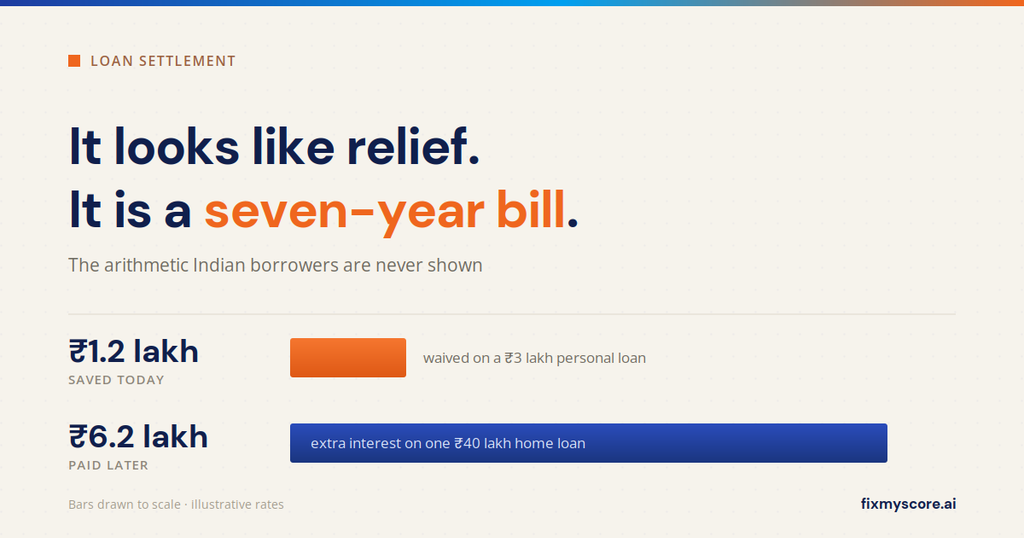
There is a particular kind of phone call that arrives after four or five months of missed EMIs. A recovery officer offers a number — pay ₹1.8 lakh against the ₹3 lakh outstanding, and the account closes. The relief is enormous. The caller is not lying: the account really does close, the calls really do stop, and ₹1.2 lakh really does stay in your pocket.
What almost nobody explains on that call is what gets written into your credit file afterwards, and what that entry costs over the following seven years. For a large share of Indian borrowers, the answer is several times the amount they saved.
Three words that look similar and are not
Indian credit reports use a set of account statuses that sound almost interchangeable to a layperson and mean radically different things to an underwriter.
| Status | What it means | How lenders read it |
|---|---|---|
| Closed | You repaid the full principal and interest per the contract. | Neutral to positive. No adverse signal. |
| Settled | The lender accepted less than the full amount as final discharge. | Adverse. Evidence of an obligation not met in full. |
| Written-off | The lender booked the unpaid dues as a loss after prolonged non-payment. | Strongly adverse. You may still legally owe the money. |
The trap sits in ordinary English. “Settled” carries a connotation of resolution — a matter settled, a dispute settled. TransUnion CIBIL has published a case study of exactly this confusion: a borrower whose education loan was rejected because of a “settled” entry from an earlier personal loan, and who assumed the word was a positive one. It is not. We have written a fuller breakdown of what each account status actually signals to a lender, because the confusion is close to universal.
The three costs, stacked
Cost one: the immediate score drop
Industry estimates converge on a 75–100 point fall following a settlement, and larger falls where the account was material relative to the rest of the file or where the delinquency preceded it. That is not a rounding error. It is often the difference between the band where mainstream banks lend and the band where only high-rate NBFCs will look at you.
Cost two: seven years of visibility
Under India’s credit information framework, credit data is retained for a minimum of seven years. A settlement recorded in June 2026 remains visible until roughly 2033. Every lender who pulls your file in that period sees it. The practical weight of the entry does fade after two to three years of clean repayment behaviour — lenders discount old adverse events — but it does not disappear, and it does not stop being a question you have to answer.
Cost three: repricing, which is where the real money is
This is the cost nobody models, and it dwarfs the other two. Consider an ordinary sequence: a borrower settles a ₹3 lakh personal loan at ₹1.8 lakh, saving ₹1.2 lakh. Four years later, with the settlement still on file, they apply for a ₹40 lakh home loan over 20 years.
| Scenario | Rate offered | Monthly EMI | Total paid over 20 years |
|---|---|---|---|
| Clean file (loan closed in full) | 8.6% | ₹34,970 | ₹83.9 lakh |
| Settlement on file | 9.6% | ₹37,550 | ₹90.1 lakh |
| Difference | +1.0% | +₹2,580 / month | +₹6.2 lakh |
₹1.2 lakh saved. ₹6.2 lakh paid. A net cost of roughly ₹5 lakh — and this assumes the home loan is approved at all, which for many borrowers with an adverse entry it is not. Rates are illustrative; the structural point holds at any spread.
The spread used above is conservative. Risk-based pricing in Indian retail lending routinely produces wider gaps than a single percentage point, and an adverse status frequently triggers a higher down-payment requirement or a demand for a co-applicant rather than a rate adjustment alone. Before agreeing to any settlement, it is worth running your own numbers — our settlement impact calculator compares settling, part-paying and full repayment side by side using your actual outstanding amount and time horizon.
When settlement genuinely is the right decision
It would be dishonest to argue that settlement is never correct. There are situations where it clearly is:
- The alternative is a write-off. A written-off account is a worse entry than a settled one, and you may still legally owe the debt. If the realistic choice is between the two, settle.
- The debt is genuinely unpayable. Where income has collapsed and the outstanding cannot be serviced under any restructuring, settlement converts an open-ended liability into a closed one.
- You have no near-term credit need. If you will not seek a home loan, car loan or business loan for several years, the repricing cost is deferred far enough to weigh differently.
- Legal exposure is escalating. Where recovery proceedings are underway, the calculus stops being purely financial.
What is almost never correct is settling as a convenience — because the calls are stressful and the number sounds good — when a restructuring, a tenure extension, a moratorium or even a slower part-payment plan was available and unexplored. Ask for those first, in writing, and make the lender decline them in writing.
If you must settle, negotiate the reporting, not just the amount
Borrowers negotiate hard on the settlement figure and accept whatever gets reported. That is backwards. The reported status is worth more than the discount.
- Ask for a full-and-final payment reported as “Closed.” Some lenders will agree, especially where the shortfall is small. It costs you more today and saves you far more later.
- Get the settlement terms in writing before you pay. The letter should state the amount, that it discharges the account fully, and the status that will be reported to bureaus.
- Obtain the No Objection Certificate / No Dues Certificate. Without it, you have no documentary basis for any subsequent correction.
- Diarise the reporting date. Under the RBI framework, lenders now report to bureaus weekly. Check your file within a month and confirm the status matches the letter.
- If it is misreported, dispute it immediately. Where a formal settlement is wrongly recorded as written-off or defaulted, you have a clear right to dispute, and the complaint must be resolved within 30 calendar days — with ₹100 per calendar day payable to you beyond that.
Repairing an entry that already exists
If the settlement is already on your file, there are two distinct tracks, and they are often confused.
Track one: upgrade the status. Pay the waived balance to the original lender, take the NOC, and ask them to report the account as closed. The bureau updates on the lender’s instruction — never on yours alone. This is the only route that removes the adverse signal rather than diluting it, and we have set out the full procedure in our guide to changing a settled entry on your report. The same logic applies to a written-off entry, with the added complication that the underlying liability may survive the write-off.
Track two: outbuild it. Where the balance cannot be paid, the entry stays and you construct a repayment record around it. Twelve to twenty-four months of clean behaviour — zero missed payments, utilisation held below 30%, no unnecessary applications — measurably shifts how lenders weigh an old adverse event. It is slower and it works. Our step-by-step version of that plan is here.
The underlying problem
India added retail credit faster than it added credit literacy. CRIF High Mark’s How India Lends data put total retail loans outstanding at ₹170.2 lakh crore as of March 2026, up 16.6% year-on-year, with the sharpest historical stress concentrated in small-ticket unsecured lending and among new-to-credit borrowers — precisely the cohort most likely to receive a settlement call and least equipped to evaluate it.
That asymmetry is the actual issue. The recovery officer knows exactly what “settled” does to a credit file. The borrower, in the overwhelming majority of cases, does not. Closing that gap before the call arrives is worth more than any negotiation tactic afterwards.
Frequently asked questions
How much does a loan settlement reduce a credit score in India?
Commonly cited industry estimates place the immediate fall at 75–100 points, and larger where the settled account was significant relative to the rest of the credit file or where missed payments preceded the settlement. The exact impact depends on your overall credit history.
How long does a settled status stay on a credit report?
Credit information in India is retained for a minimum of seven years, so a settled entry typically remains visible for that period. Its practical influence on lending decisions weakens after two to three years of consistent, clean repayment behaviour.
Can a settled status be removed?
Not by request alone. The realistic route is to pay the waived balance to the original lender, obtain a No Objection Certificate, and have the lender report the account as closed. A bureau will only update on the lender’s instruction. If a settlement has been misreported as written-off or defaulted, that is a factual error and can be disputed directly.
Is settlement better or worse than a write-off?
Settlement is the less damaging of the two. A write-off signals prolonged non-payment, is read more severely by lenders, and does not extinguish your legal liability for the outstanding amount.
