
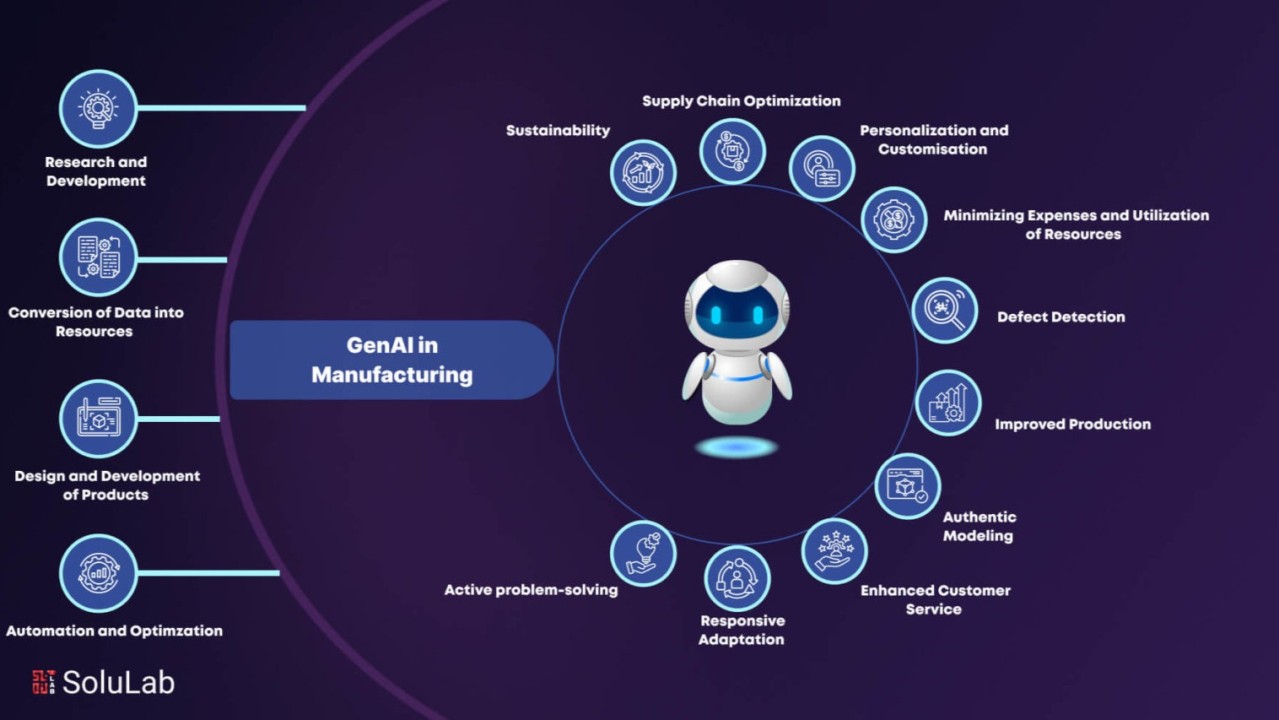
Generative Artificial Intelligence (GenAI) is a transformative branch of AI that is reshaping operations across industries. Unlike traditional AI systems that analyze data to generate insights, GenAI goes a step further—it creates new, original outputs based on the data it processes. These outputs can include text, code, images, simulations, and more, often reflecting human-like creativity and reasoning.
In IT environments, GenAI is proving especially valuable. It enhances functions such as software development, data management, cybersecurity, and service operations by generating intelligent outputs that reduce manual effort and improve accuracy.
GenAI is also strengthening collaboration between IT and business teams. By accelerating the no-code and low-code movement, it enables employees—beyond just technical teams—to prototype applications, build dashboards, and design workflows through conversational interfaces. This significantly shortens prototyping cycles, improves requirement clarity, and enables faster iterations, leading to greater business agility and stronger adoption of digital solutions.
GenAI in Software Development
In software engineering, GenAI models trained on vast repositories such as GitHub can generate high-quality code from simple descriptive prompts. This accelerates development timelines while embedding best practices and reducing human error.
A notable example is Google’s AlphaCode, which demonstrates the power of generative AI in understanding multiple programming languages and producing accurate code from brief inputs.
GenAI in Data Management
GenAI automates data cleansing, consolidation, integration, and augmentation. It can generate synthetic data, perform data labeling and classification, anonymize sensitive information, and streamline overall data governance processes. These capabilities make enterprise data more usable, secure, and scalable.
Automation Across IT Operations
GenAI significantly improves routine IT operations by automating tasks such as network configuration, system updates, and troubleshooting. It also enhances help desk operations by resolving common queries autonomously, allowing IT teams to focus on more strategic initiatives.
Why is GenAI Indispensable in IT?
The growing importance of GenAI in IT stems from its ability to drive measurable transformation:
Innovation acceleration:
GenAI shortens development cycles by automating digital artifact creation, enabling faster solution delivery.
Proactive security:
By simulating advanced cyber threats, GenAI helps strengthen defense mechanisms against evolving risks.
Cost optimization:
Automation of repetitive tasks reduces operational costs and improves resource allocation, freeing teams to focus on strategic initiatives.
As organizations increasingly rely on IT as a core business enabler rather than a support function, GenAI is helping transition operations toward more strategic, scalable, and cost-efficient models.
The Current Landscape of Generative AI in IT
Adoption of GenAI is moving rapidly from pilot programs to full-scale enterprise implementations. According to Bain & Company, 85% of IT leaders consider generative AI a top investment priority. One-third plan to invest more than $5 million in GenAI initiatives—up significantly from previous years.
Similarly, Precedence Research estimates that the global generative AI market will grow from USD 37.89 billion in 2025 to over USD 1005 billion by 2034, reflecting a CAGR exceeding 44%.
Key Trends in IT Operations
Enhanced automation:
GenAI is advancing from rule-based bots to intelligent systems capable of code generation, observability insights, and predictive maintenance.
Improved customer interaction:
AI-driven service tools are handling increasing volumes of both voice and non-voice interactions, improving efficiency in IT service centers.
Advanced testing and development:
GenAI supports test script creation, unit testing, integration testing, and debugging—reducing development cycles while improving quality.
Knowledge management:
AI-powered knowledge systems improve information retrieval, enabling faster decision-making and organizational agility.
Strategic Approaches to Integrating GenAI in IT
Organizations typically choose among three primary approaches:
1. Developing a Custom In-House GenAI Stack
This involves building tailored AI solutions aligned to specific IT needs.
Advantages:
- Seamless integration with existing systems
- Greater control over security and compliance
- Competitive differentiation through customized innovation
2. Using GenAI Point Solutions
Point solutions are standalone third-party applications focused on specific use cases like troubleshooting or optimization.
Advantages:
- Faster deployment
- Lower technical overhead
- Rapid time-to-value
3. Adopting a Comprehensive Platform Like ZBrain
ZBrain™ is an enterprise-grade AI enablement ecosystem designed to help organizations assess, build, and scale AI solutions without deep AI expertise.
It includes:
- ZBrain Center of Intelligence (CoI) – AI opportunity discovery
- ZBrain XPLR – AI readiness assessment and roadmap creation
- ZBrain Builder – Low-code agentic AI orchestration platform
What is ZBrain Builder?
ZBrain Builder is the core low-code agentic AI platform that enables organizations to design, deploy, and orchestrate intelligent agents and workflows through an intuitive visual interface called Flows.
Key Capabilities of ZBrain Builder
- Low-code workflow design
- Agentic AI orchestration
- Model-agnostic integration (GPT-5, Gemini, Claude, etc.)
- Enterprise knowledge base management
- Tool and API integration
- Compatibility with Slack, Teams, Salesforce
- Multi-agent collaboration
- Monitoring and governance controls
- SOC 2 Type II, ISO 27001, HIPAA, and GDPR compliance
By combining orchestration, retrieval, and reasoning, ZBrain Builder enables enterprises to move from AI experimentation to large-scale automation with confidence.
Measuring ROI of Generative AI in IT
Evaluating GenAI ROI involves assessing both financial returns and operational improvements.
Key ROI Indicators
Reduced operational costs:
Automation of network management and maintenance lowers labor costs and downtime.
Faster incident resolution:
Real-time data analysis improves system uptime and reduces mean time to resolution.
Optimized resource allocation:
Dynamic infrastructure management prevents underutilization or overprovisioning.
Improved service delivery:
AI-powered help desks increase first-call resolution rates and reduce support tickets.
These benefits demonstrate how GenAI improves both day-to-day efficiency and long-term strategic positioning.
Challenges in Deploying Generative AI in IT
Despite its potential, GenAI implementation presents challenges:
- High computational costs
- Integration with legacy systems
- Risk of technical debt
- Workforce transformation needs
- Data privacy and security risks
- Algorithmic bias concerns
- ROI measurement complexities
- Intellectual property and compliance issues
Organizations must establish governance frameworks and centers of excellence to ensure responsible, ethical deployment.
Best Practices for Implementing GenAI in IT
To maximize success:
- Align AI initiatives with strategic goals
- Implement strong data governance
- Engage stakeholders early
- Design scalable, cloud-ready architectures
- Address ethical and legal considerations
- Invest in continuous learning
- Monitor performance rigorously
Future Trends of Generative AI in IT
The evolution of GenAI in IT will shape the next decade of enterprise technology.
AI as a Service (AIaaS):
Cloud-based AI capabilities will accelerate adoption while reducing infrastructure burdens.
Domain-specific AI models:
Customized AI solutions tailored to specific IT functions will improve precision and performance.
Advanced automation:
Complex network monitoring, diagnostics, and cybersecurity tasks will increasingly be automated.
Enhanced NLP:
More sophisticated natural language processing will enable deeper conversations and more advanced coding assistance.
Synthetic data and simulation:
GenAI will support predictive modeling through advanced scenario simulation.
Responsible AI (RAI):
Transparency, fairness, and compliance will become central to AI strategy.
Endnote
The integration of generative AI into IT operations marks a shift from manual and semi-automated systems to intelligent, predictive, and autonomous environments. By improving efficiency, reducing costs, and enhancing decision-making, GenAI is transforming IT from a support function into a strategic growth engine.
Organizations that embrace AI-driven IT operations will be better positioned to innovate, scale, and compete in an increasingly digital world.
Ready to accelerate your IT transformation? Explore how ZBrain’s generative AI capabilities can modernize your infrastructure with intelligent automation, advanced personalization, and streamlined workflows.
